
Blue pottery at a glance
| Origin | Jaipur, Rajasthan (also made in nearby Sanganer, Mahalan and Neota) |
| Craft type | Glazed ceramic with a quartz-based body (a frit ware, not clay) |
| Main materials | Quartz powder, powdered glass, Multani mitti (fuller's earth), borax, natural gum, water |
| Technique | Moulded by hand, painted with metal oxides, glazed, fired once at a low temperature |
| Signature colours | Cobalt blue, turquoise (copper green) and white |
| Known for | Persian-style florals, birds and arabesques on a white ground |
| GI status | Registered Geographical Indication: "Blue Pottery of Jaipur" |
| Typical products | Vases, plates, bowls, coasters, tiles, door knobs, trinket boxes |
| Price range on KLAYVA | ₹[X]–₹[Y] [from live listings] |
| Good for | Housewarming and Diwali gifts, wall and shelf décor |
| Care | Handle gently, wipe with a damp cloth, keep away from sudden heat |
What is blue pottery?
Blue pottery is Jaipur's best-known ceramic craft. Unlike almost every other pottery tradition in India, it contains no clay. Potters make a dough from ground quartz, glass and fuller's earth, shape it in moulds, paint it by hand and glaze it before a single low firing.
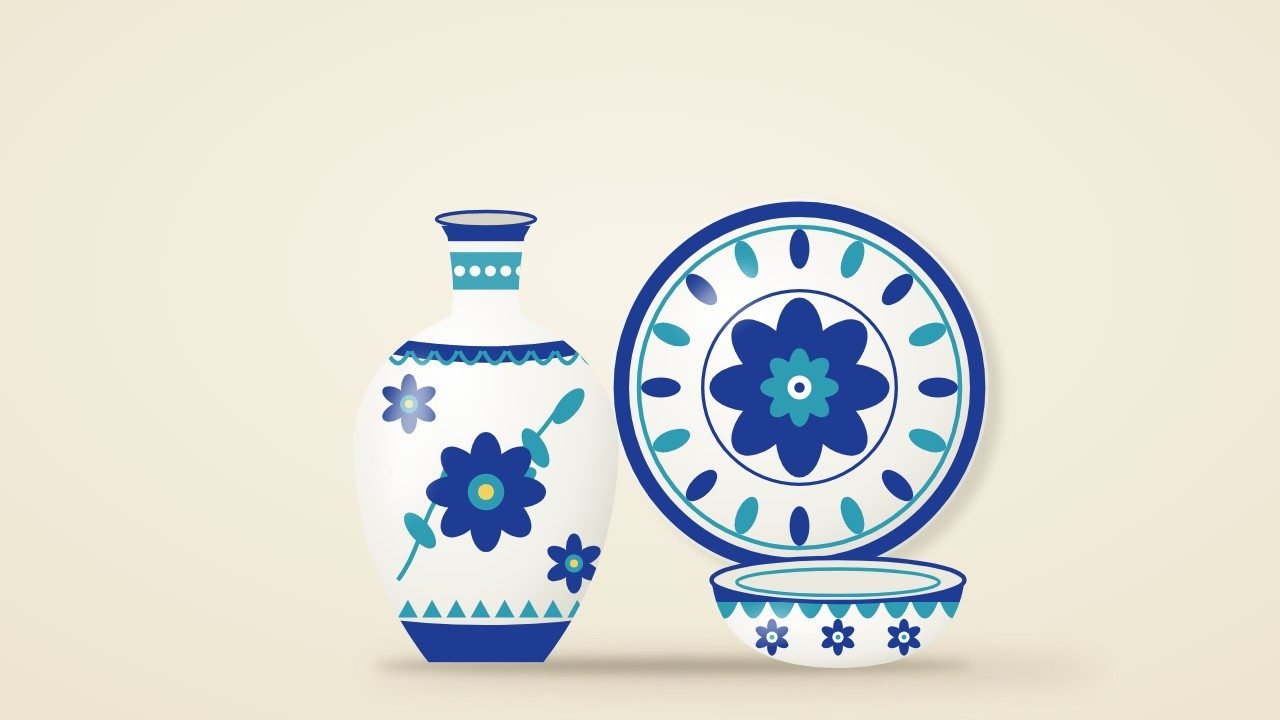
The name comes from the colour. Cobalt oxide gives the deep blue that dominates every piece, and copper oxide gives the turquoise-green that often sits beside it. Patterns are painted on a white ground: flowing creepers, flowers, birds, and the geometric borders of Persian and Mughal design.
Because there's no clay, the finished pottery feels different in the hand. The surface is smooth and glassy, the colours are bright and slightly translucent, and pieces are lighter than stoneware of the same size. The trade-off is strength. Low firing makes blue pottery more delicate than everyday ceramics, which is why most pieces are made to be looked at and handled with care rather than used roughly in the kitchen.
Where does blue pottery come from? History and origin
Blue pottery came to Jaipur from a much older blue-and-white tradition that travelled from West Asia, through Persia and Central Asia, into India. Turkic rulers brought glazed tilework to India around the 14th century, the Mughals adopted it, and the craft reached Jaipur by the 19th century.
The cobalt blue-and-white style began in the Islamic world and was refined in Persia and Central Asia, where potters combined Chinese glazing with Persian decoration. In India it first appeared as glazed tiles on mosques, tombs and palaces. Under the Mughals the technique spread to Delhi.
Accounts differ on exactly when it reached Jaipur. Some place it in the 17th century. The version most often told links it to Maharaja Sawai Ram Singh II, who ruled Jaipur from 1835 to 1880 and is said to have sent local craftsmen to Delhi to learn the technique, then set up a pottery school in his city. A 1916 issue of the Journal of Indian Art already described Jaipur's ware as an improvement on Delhi's.
By the 1950s the craft had almost disappeared. It was revived by the Jaipur artist Kripal Singh Shekhawat, with support from Kamaladevi Chattopadhyay, a leading figure in India's handicraft revival, and Rajmata Gayatri Devi of Jaipur. Their work brought blue pottery back into Jaipur's workshops, and it's now one of the city's signature crafts. It also holds a Geographical Indication (GI) registration as "Blue Pottery of Jaipur".
How is blue pottery made?
Blue pottery is made by pressing a quartz-and-glass dough into moulds, drying and smoothing the piece, painting it by hand with metal oxides, glazing it, and firing it once in a kiln. A single piece passes through many hands and takes several days.
Make the dough. Quartz powder, powdered glass, Multani mitti, borax and natural gum are mixed with water and kneaded into a stiff dough.
Roll it out. The dough is rolled into a flat sheet a few millimetres thick, often called a chapati in the workshop.
Shape it in a mould. The sheet is pressed into a plaster mould. Hollow forms like vases are packed with a filling of sand or ash to hold their shape. Bases and necks are joined by hand.
Dry and refine. The piece dries for a day or two, then is taken out of the mould, smoothed, and sanded until the surface is even.
Coat and paint. The piece is given a white base coat. Artisans then paint the design freehand with brushes, using cobalt oxide for blue and other metal oxides for green, yellow and brown, each mixed with gum.
Glaze. A clear glaze is applied over the painting.
Fire once. Pieces are fired for a few hours at a relatively low temperature, then left to cool slowly in the kiln for two to three days before unloading.
Because everything happens in one firing, mistakes can't be fixed later. Cracks, glaze runs and colour shifts mean some pieces are lost in every batch.
[Add 3–4 process photos from a KLAYVA artisan's workshop, with captions in their words.]
Materials, colours and motifs
Materials
- Quartz powder: the main body material, in place of clay
- Powdered glass: helps the body fuse and gives the glassy finish
- Multani mitti (fuller's earth): adds workability
- Borax and gum: binders that hold the dough together
- Metal oxides: cobalt for blue, copper for turquoise-green
Colours The palette is small and deliberate: cobalt blue, turquoise and white. Some workshops add yellow, brown or green for contrast. Modern pieces sometimes use pastel or non-traditional colours, but classic blue pottery is blue-dominant.
Motifs
- Flowering creepers, lotus and other flowers
- Birds and animals
- Persian geometric borders and Mughal-style arabesques
- In more recent work: deities, human figures and architectural details from Jaipur's palaces
How to identify genuine Jaipur blue pottery
Genuine blue pottery shows signs of the hand and the material. Check these before you buy:
It isn't heavy. A quartz body is lighter than stoneware or porcelain of the same size.
The painting is freehand. Lines vary slightly in thickness, and the pattern on one side won't perfectly match the other. Identical, razor-sharp patterns usually mean a print or decal.
The colours sit under the glaze. Run a finger over the design. On real blue pottery it's smooth, with no raised paint or printed edge.
Small irregularities are normal. Tiny pinholes, slight glaze pooling or a gentle wobble in shape are signs of a single hand-firing, not defects.
The base is often unglazed or rough. Look underneath for the natural body.
The maker is named. On KLAYVA, every blue pottery piece links to the artisan who made it, so you know exactly where it comes from.
The price is realistic. Hand-painted pieces take days. A very cheap "blue pottery" set is likely machine-made ceramic with a blue print.
Blue pottery vs Khurja pottery
Both are glazed ceramics from North India, and both are often sold as "blue pottery", but they're very different crafts.
| Jaipur Blue Pottery | Khurja Pottery | |
| Where | Jaipur, Rajasthan | Khurja, Bulandshahr, Uttar Pradesh |
| Body | Quartz, glass and fuller's earth, no clay | Clay-based ceramic with quartz and feldspar |
| Shaping | Moulds and hand finishing | Mostly the potter's wheel and moulds |
| Firing | Once, at a low temperature | Higher temperature, sturdier result |
| Colours | Cobalt blue, turquoise, white | Wide range of glazes: blues, browns, greens, multicolour |
| Feel | Light, glassy, delicate | Heavier and sturdier |
| Best for | Décor, gifting, light serving | Everyday mugs, dinnerware, planters |